“Go, inquire of Baal-zebub”
A prophet clad in hair and leather appears in Israel to usher in divine judgment and, perhaps, divine salvation. He announces the end of Beelzebub’s reign and the restoration of the kingdom of God. For this work he is persecuted by Israel’s rulers, and while hidden in the wilderness for forty days he considers abandoning his dangerous ministry. Yet there in his temptation animals and angels sent from heaven aid and comfort him. The prophet is then granted a personal revelation of the Lord on a sacred mountain. Newly renewed, and empowered by holy spirit, he proceeds to dismantle the apostasy of his people through a combination of wonderworking and political machination. The treacherous religious establishment is dealt a mortifying blow by his speech and deeds, and Israel witnesses miracles from the one true God: the dead are raised, food is multiplied, lepers are cleansed, waters are trampled down, and jars are filled with nectar. God is with this troublesome prophet, not with the king or his priests. The time for Jacob to repent or perish has indeed come.
Now I know that you are a man of God and that the word of the Lord in your mouth is truth!
To solidify his legacy in the land, the prophet selects disciples to carry on as controversial promoters of God’s reign after he is gone, or rather, after he has disappeared. They too will suffer opposition, sacrificing their normal lives for their improbable gospel: “the Lord indeed is God.” Nonetheless, by the hand of such prophets mighty deeds proliferate, the strength of God’s name is upheld, foreign commanders behold the Lord’s supremacy, and the people are rescued time and again from the enemies at their gates. The man of God at last anoints a new king over Israel and he violently overthrows the old regime and tears down its temple of pollution. A protracted period characterized by worship, peace, and victory ensues.
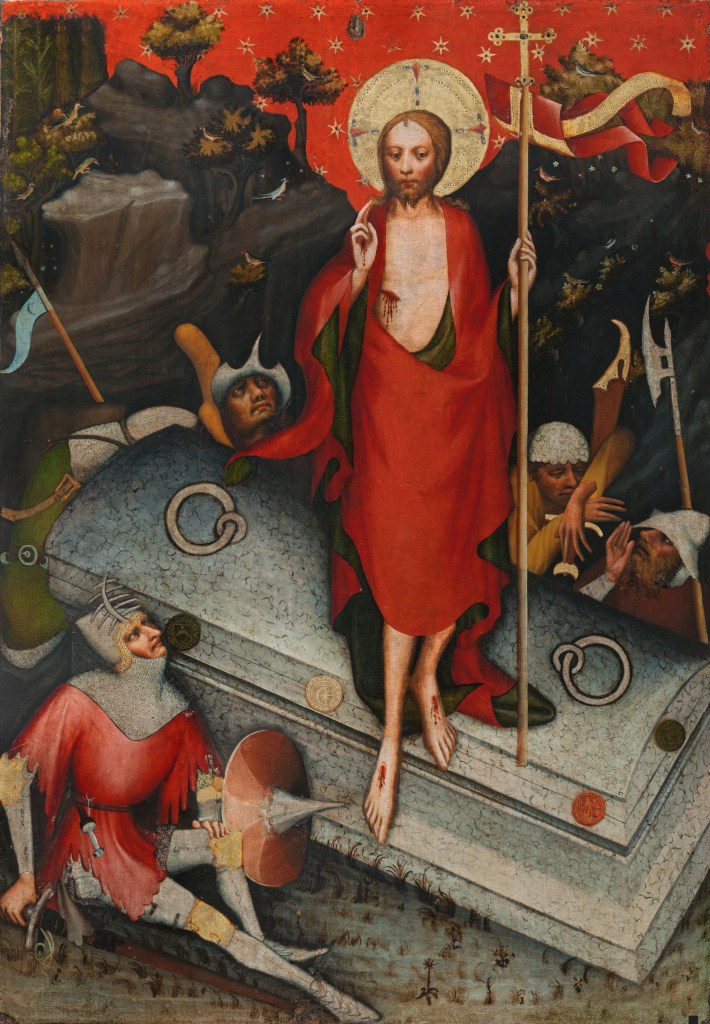
Thus, in the span of a generation, God’s kingdom is established over the people, and our narrative ends, unexpectedly, with a man risen from the grave, a final testament to the prophet’s unquenchable power and irrefutable word.
Elijah cycle redux
This, of course, is the story of Elijah, Elisha, and Jehu, and their war against the cult of the god Baal promoted by the Omride Dynasty of Israel—by King Ahab and his Phoenician wife, Queen Jezebel.
With some slight modifications, it is also the story told by the New Testament, the story of John the Baptist, Jesus, Peter, Paul, and the long-awaited Davidic Kyffhäuser, set to appear on the day of God’s wrath and consolation, and their crusade, first against the lawless Jew, and then against the idolatrous Greek.
Both narratives, the old and the new, follow the same redemptive story arc: strange prophets are equipped to grapple with the wicked and unresponsive leaders of Israel. Miracles confirm their message regarding God’s authority and his intention to extend his rule. Persecution follows but is ultimately unsuccessful and counterproductive. God humiliates the gods, destroys his enemies, turns their temples into latrines, and installs a king for himself, all with the result that the surrounding nations come to fear the Lord.
When coupled with the trove of literary details shared between the Gospels & Acts and the Elijah-Elisha traditions in the books of Kings, it is clear that this broader pattern of imitation is intentional. For the Synoptic Evangelists, the heroic cycle patterned by Elijah, Elisha, and Jehu was again underway.
Here are a few more examples of this parallel storytelling:
- The two pericopes in which Elijah and Elisha each resurrect a boy serve as templates for Jesus’ raising of a girl in Mark 5, his raising of a widow’s son in Luke 7, Peter’s raising of Dorcas in Acts 9, and Paul’s resuscitation of a boy in Acts 20.
- Elijah provides an abundance of oil and meal for a faithful Syrian woman who gives her last morsels first to the Israelite prophet. Jesus provides an exorcism for a faithful Syrian woman who contents herself with the crumbs from Israel’s table in Mark 7.
- The unbelieving king of Israel falls through a lattice and remains bedridden until his death in accordance with the word of God delivered by Elijah. In Mark 2 Jesus heals the believing paralytic lowered down through the roof such that he can pick up his bed and walk.
- Elijah predicts his final departure thrice and his disciple Elisha responds loyally to each warning. Jesus predicts his execution three times and Peter responds disloyally thrice before the crowds.
- Elisha produces food to feed a hundred men from twenty barley loaves and commands his skeptical servant to distribute it to the people. Some is left over. This is the plot also of the Gospel feeding accounts in Mark 6 & 8.
- Elisha’s physical and spiritual cleansing of a leprous Syrian commander has left its mark on both Jesus’ parallel cure in Mark 1 and on the noble centurion “made clean” through Peter in Acts 10.
- Jehu arrives at Naboth’s stolen vineyard property to destroy Ahab’s wife and their son, King Jehoram. Multiple messengers from the king approach Jehu one at a time but each falls in line behind him. Finally, Jehoram himself comes out to meet Jehu and seek his peace but is killed by Jehu’s arrow. This sequence is reversed in Jesus’ parable of the wicked tenants of the vineyard in Mark 12.
The new Jehu
The literary material encapsulating the deeds of Elijah, Elisha, and Jehu was incorporated into a work called the Book of the Annals of the Kings of Israel before it was redacted by the Deuteronomistic scribal school as part of the Biblical books now known as 1 & 2 Kings. This is to say that these are stories from the perspective of the renegade northern Israelites who fought for the Lord against Baal.
If it is this earlier work that first outlined the restoration of a Yahwistic government in the northern kingdom over a period of about forty years, resulting not only in the long, prosperous, and expansionistic reigns of Jehu’s heirs, Jehoahaz and Jeroboam II (2 Kings 13:22-25, 14:23-29),2 but also in the decapitation of Baalism in Judah (2 Kings 11), then the letters of Paul, the Gospels of Mark & Matthew, and the Apocalypse of John attest to the corresponding Christian belief that the messianic Son of David would come to raise the dead and install God’s imperium over all the kingdoms of the pagan world within the lifetime of the original disciples. For some of these Christians, namely Mark, Matthew, and the Pauline disciple responsible for the second letter to the Thessalonians, all of this was going to occur shortly after the demolition of the Temple in Jerusalem. Such would be the fulfillment of what had been prefigured some forty years earlier, first by the prophet’s rampage at the Temple, and second by his resurrection out of the tomb—the very two events that conclude the Elijah-Elisha-Jehu cycle.
For Christians who lived beyond the shadow of Israel’s war with Rome (AD 66-74), and beyond the death of the Last Disciple, however, men like Luke, Justin Martyr, and Montanus, the quest for God’s kingdom would achieve its resolution a little farther along. The prophet Elijah, now the revenant herald of the Last Days (Malachi 4:5), had indeed returned as the fiery apocalyptic spirit that possessed the early Christian community, but the new Jehu, the warrior messiah who would come with reward and punishment in his hand, had not yet fulfilled the purpose of his anointing, bestowed by holy spirit once in the Jordan River and again at his resurrection from the dead. Nor had the new Jeroboam II arisen to subdue the neighboring nations and unlock lasting material bounty (cf. Psalm 72). Surely Christ’s imminent arrival in their likeness was still on the docket, panoplied angels still in tow.
Regardless of the exact timing of the impending messianic age, Christians of the first three centuries recognized that demonic deities and their earthly clients (e.g. Caesar) remained dominant over the world of Classical Antiquity, unresponsive to the lordship that Jesus had obtained, apparently, after his ignominious death and subsequent disappearance. Yet one day, at the behest of this Jesus, divine wrath would overtake the world’s idolatrous system and replace it with the kingdom of God, a kingdom ruled by God’s people. Those at the helm of the pagan empire, all the sons of Ahab, would be cut down, and God would set his own king upon his holy hill. Perhaps this time no golden calves would sink the righted ship and send the people of God into the deep.3
Stories from ancient Israel
So, if some of the earliest Christian texts closely resemble the Elijah-Elisha-Jehu narrative cycle, albeit in an apocalyptic form, complete with the Devil, his demons, and the looming last judgement of the living and the dead, the Book of the Annals of the Kings of Israel is itself a loose recapitulation of the Exodus myth, here told by patriots of the northern Israelite kingdom during the Jehuite Dynasty, conceivably from the court of Jeroboam II.4 For such scribes, Elijah, Elisha, and Jehu embodied prophet-warriors like Moses, Aaron, and Joshua—Hebrew heroes who liberated their people from foreign pagan rule and conquered for them a homeland with God’s help and God’s direction. Despite the eventual appropriation5 of the Book of the Annals of the Kings of Israel by the largely unsympathetic Judahite historians who created the Deuteronomistic History, this collection of folktales from the north represents a crowning achievement of Israelite literature and theology that should be ranked alongside the Exodus saga and the legendarium of the Judges. It is within these epic stories, within this proto-εὐαγγέλιον, that early Christians found a highly suitable typological substrate—one that has been widely underappreciated for all the predictable reasons.
Jeroboam restored the border of Israel from Lebo-hamath as far as the Sea of the Arabah, according to the word of the Lord, the God of Israel, which he spoke by his servant Jonah son of Amittai, the prophet who was from Gath-hepher. For the Lord saw that the distress of Israel was very bitter; there was no one left, bond or free, and no one to help Israel. But the Lord had not said that he would blot out the name of Israel from under heaven, so he saved them by the hand of Jeroboam son of Joash.
2 Kings 14:25-27
1—Elijah means “My God is Yahweh,” Elisha means “My God is salvation,” and Jehu means “Yahweh is He (i.e. God).” The name Jesus is essentially the Yahwistic version of the Elohistic name Elisha, meaning “Yahweh saves.” All of these names concern the identity of the highest deity, Israel’s God, and his rightful ownership of the nations.
2—At God’s discretion, Jeroboam II extended the borders of Israel to their Solomonic precedent, and he even captured Damascus for a time.
3—Elijah and Elisha do not comment on the Yahwistic calf idols at Dan and Bethel erected by Jeroboam I. The Dueteronomistic redactor is careful to remind his readers that the House of Jehu did not turn away from this offense.
4—Jehu’s house was the longest lasting and most powerful dynasty in the history of the northern Israelite kingdom.
5—Or should we say “preservation”?

 Scribes of the Kingdom
One thought on “The Elijah option: Contributions of Jehuite propaganda to early Christianity”