Josephus’ account of the war in the north
In AD 67 the Roman general Vespasian arrived on the shores of Ptolemais with his son Titus. They had been sent by the emperor to quell a Jewish rebellion in and around Judea. Upon landing, Vespasian and his legions proceeded inland to regain control of Galilee and the Decapolis. One city in this region, the mostly Gentile Gadara, had been captured and plundered by Jewish forces in the early days of the revolt. Vespasian, however, found Gadara poorly defended and after slaughtering his opponents, he set fire to the city and neighboring towns. Thus Vespasian exerted his control over the territory.
In the years following, before marching upon Jerusalem and then, finally, Masada,1 Vespasian came upon Gadara a second time. This time the Romans were met by a significant number of insurgents. Although many of the townspeople desired to surrender peaceably to the approaching legions, the Jewish faction fortified the city for war. To stamp out dissent, the rebels “barbarously” executed one prominent citizen of Gadara, Dolesus, because he had conspired to send a delegation of peace to the Roman army. They mangled his body in anger.
In the end, the party that desired to surrender broke down Gadara’s wall and invited the Romans inside, thus saving the city from further destruction. Meanwhile, the rebels fled madly, like the “wildest of wild beasts,” into the countryside. There they met Roman horsemen and javelin volleys. Eventually the band of renegades was pressed onto the banks of the River Jordan. There many were slain or captured while still others were “pushed into the currents” by the Romans, some “leaping unwillingly” into the water. Carried away by the river, their corpses filled the Dead Sea, serving as a gruesome memorial of Israel’s failure to maintain its independence.
Roman victory in the north and the south
Thus ended the Jewish rebellion in the north, in the regions around the Sea of Galilee where Israelite prophets had once healed the sick and cast out demons in the name of God’s kingdom. Vespasian’s son Titus would subsequently batter the Jewish lands in the south, burning Jerusalem to the ground and subduing Jewish nationalistic fervor for some 50 years. With the Temple no more, the sacrificial cult dedicated to the Lord of the Exodus would once again cease.
Both Jews and Christians were rocked by these pivotal historical developments. Vespasian and his two sons, Titus and Domitian, had cemented themselves as divine conquerors of Israel’s feeble deity, as true sons of the true God, empowered by heaven to rule the entire world. Such claims issued from the pagan imperium would undoubtedly come into conflict with early Christian faith. Some Christians would be martyred for refusing to honor the emperor sufficiently.
It is unsurprising, therefore, that the destruction of God’s house in Jerusalem features prominently in the Gospel of Mark. Jesus’ final extended speech in Mark is an oracle regarding the war that would result in the sacking of Zion. This catastrophe, or rather, this just punishment from God, Jesus assures, would usher in the coming of the Son of Man with God’s kingdom. Israel’s God had not been defeated. Victory was still at hand for those who believed.
The fates of Legion and Gadara
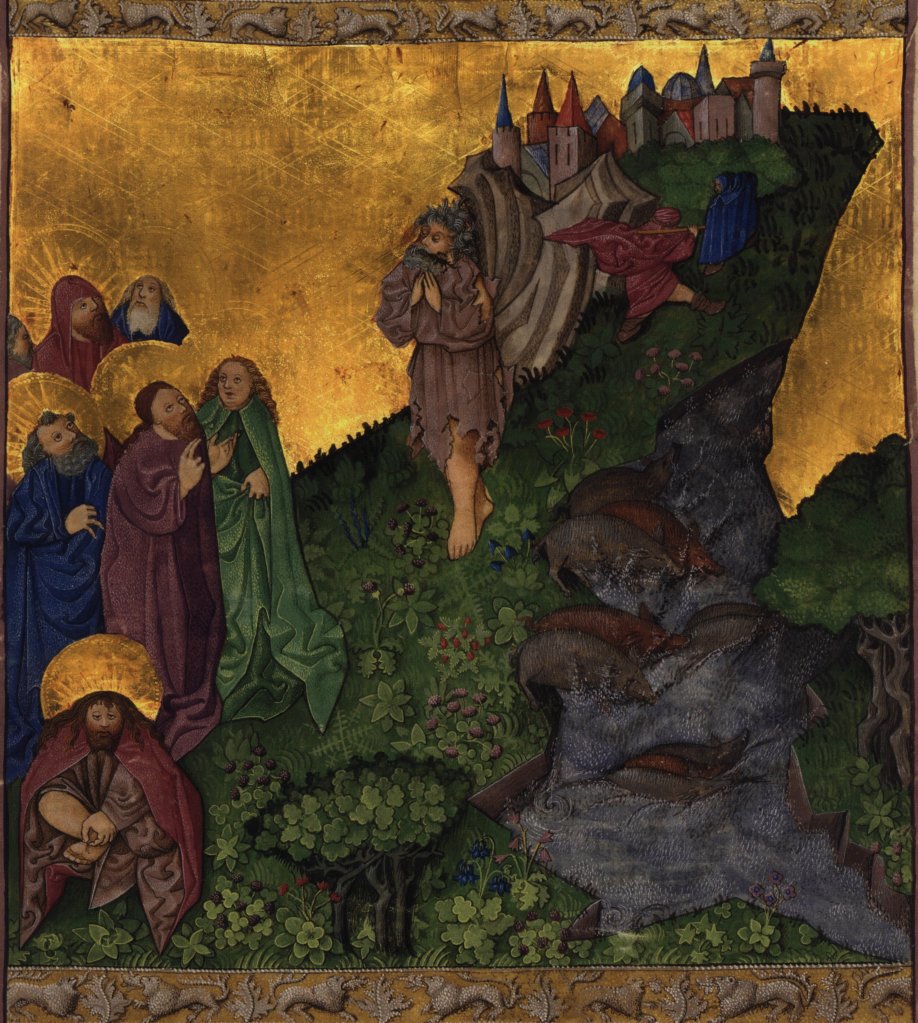
As with the defeat in the south then, early Christian reflection on the disastrous war in the north may also be preserved in the Gospel of Mark. For instance, the exorcism of the Gerasene Demoniac in Mark 5:1-20 appears to function as an anti-Roman satire that could plausibly comment on the rebellion in the north. In this story Jesus expels a demon named Legion from the country of the Decapolis by casting the evil spirits into a herd of swine that promptly rushes off a cliff and drowns in the sea. The Roman legion stationed in this region, and one of the armies involved in the conquest of Gadara a generation later, was the Legio X Fretensis, a force whose emblem was the ravenous boar (cf. Psalm 80:13). With these pieces in place, Mark seems to foreshadow Christ’s disposal of the pagan empire at his parousia. Jesus will soon cast out the authority of Rome when he comes to rule the nations.
When juxtaposed with Josephus’ narration of the First Jewish War,2 a grander constellation of parallels come into view.
- Location: While the textual reception is thoroughly confused on the issue of precise location—Did the exorcism of Legion take place in the countryside of Gerasa, Gadara, or Gergesa?3—in the end the former-demoniac heads toward his “home,” the Decapolis, to deliver news of this new Son of God who, like Vespasian, has arrived from across the sea. Thus Mark’s story takes place in the region wherein the northern rebellion was put down.
- Legion: The demon within the Gadarene man manifests its presence in feats of super-human physical strength. The townspeople try to restrain him but are unable to—even with chains and shackles. Thus the Demoniac—a symbol of Dolesus and his faction of appeasement—is entwined with an image of unmatched pagan power, the demonic Legion, in his person. The town’s attempts to coexist with this unclean spirit are strained and the Demoniac, like Dolesus later on, suffers social, spiritual, and corporeal defilement on account of his entanglement with these unclean spiritual forces, marring himself with stones.
- Drowning: Jesus transfers the demonic symbol of Roman strength from the man into swine. The pigs function as an easily-recognizable token of the particular legion that would burn Gadara and then annihilate the resistance therein. In Mark’s parodic sketch it is now the Roman army, not the Jewish rebellion, that is pressed into the water and drowned. In the words of Josephus, it is now the legion that is driven “madly” like “beasts” into the sea.
- Response: The townspeople immediately realize what the sudden and unexpected destruction of Legion means for the system of Roman power in which they inhabit and so begin to beg this new emperor from across the sea to move along without plundering their country as did Vespasian. With this fearful gesture the pagan world recoils from Christ’s usurpation of imperial power. The Gadarenes do not yet fully understand what Christ’s rule will mean.
With all this background established, Mark intends his readers to recall the catastrophe that recently occurred in the region of the Decapolis so as to reassure Christians that Jesus the Galilean can and will triumph over the brutal heathen empire in due time. Mark does not, however, care to moralize the tragedy in the north—both parties involved in the fate of Gadara, those opposed to Rome and those in favor of Rome, are victims of pagan supremacy, victims of Legion’s ominous and violent presence in their land. Yet at Christ’s own imperial advent—when God’s son comes from heaven to banish the enemies of his people and all their demonic idols into the abyss—he will put to shame even the greatest triumphs of Vespasian, Titus, and Domitian.
Those who heard Mark’s tale of overwhelming exorcistic power were thus compelled to put their trust in Jesus as God’s son and to reconsider their allegiance to the cult of the Flavian emperor.
1—Or rather, before sending his son Titus to do so. After the victory at Gadara, Vespasian returned to Rome in order to make his bid for the imperial throne, eventually prevailing over other would-be successors of Nero.
2—Vespasian’s first encounter with Gadara is described in Jewish War book 3 chapter 7 and his second encounter in book 4 chapter 7.
3—Manuscripts of the Gospel of Mark contain each of these while manuscripts of the Gospel Matthew heavily prefer “country of the Gadarenes.” “Country of the Gerasenes” is favored for Mark with a heavy degree of uncertainty. One reasonable explanation is that Mark mistook Gadara for Gerasa, another city in the vicinity with a similar name.

 Scribes of the Kingdom
I just want to say that your writings have been very helpful to me in studying the scriptures and in evaluating my own spiritual experiences. Thank you.John from Nevada
LikeLike